

Global Textile Digital Product Passport Market Trends, Pricing Analysis and Strategic Outlook (2026–2036)
Rising regulatory enforcement and demand for supply chain transparency accelerate adoption of digital identity systems across global textile value chains
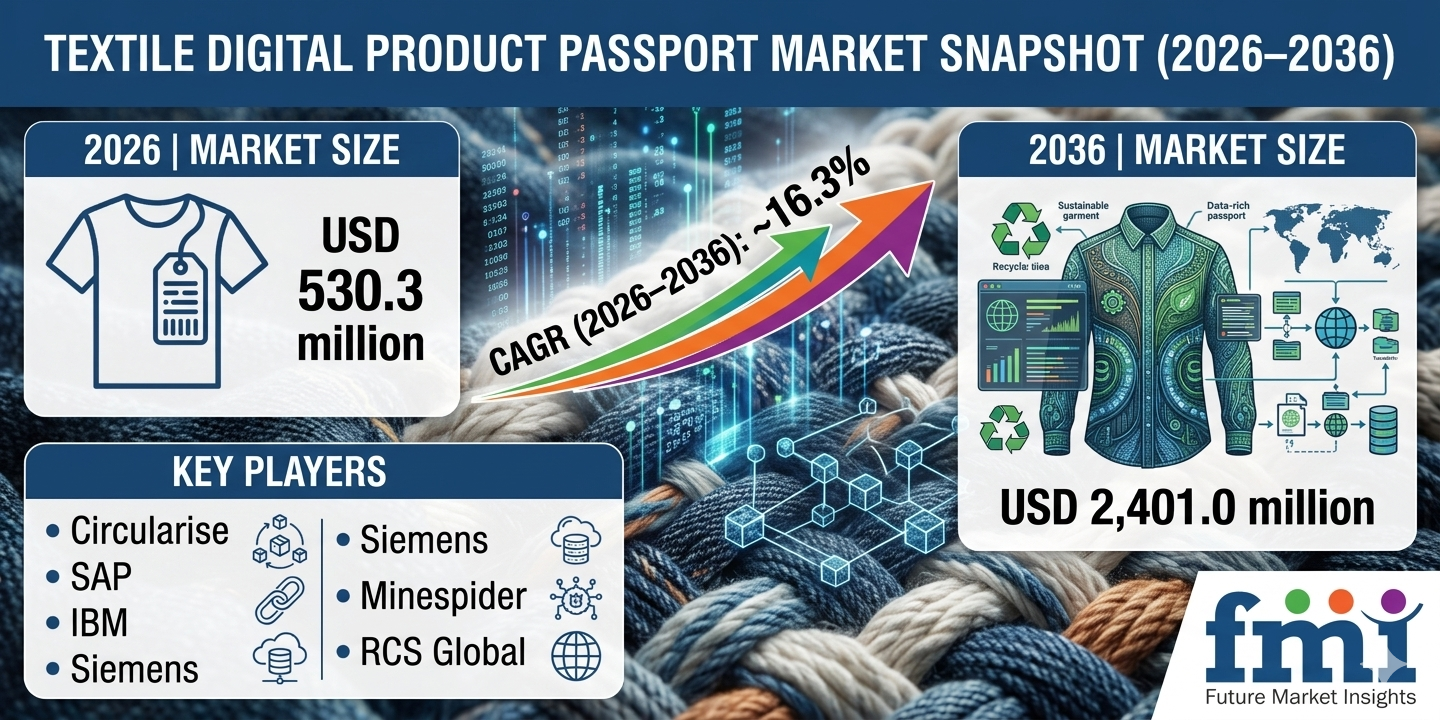
NEWARK, DE, UNITED STATES, March 18, 2026 /EINPresswire.com/ -- The global Textile Digital Product Passport Market surpassed USD 456.3 million in 2025 and is projected to reach USD 530.3 million in 2026. Over the forecast period from 2026 to 2036, the market is expected to expand at a CAGR of 16.3%, ultimately reaching USD 2,401.0 million. This strong growth trajectory is driven by tightening circular economy regulations, increasing demand for traceability, and the rapid digitization of textile supply chains.
As regulatory frameworks—particularly across Europe—mandate lifecycle transparency, textile digital product passports are evolving from compliance tools into strategic assets. These systems embed machine-readable data into garments, enabling real-time tracking of sourcing, environmental impact, and recyclability, fundamentally transforming how apparel manufacturers operate.
Textile Digital Product Passport Market Snapshot (2026–2036)
• Market size in 2026: USD 530.3 million
• Market size in 2036: USD 2,401.0 million
• CAGR (2026–2036): ~16.3%
• Leading technology: Blockchain-based traceability
• Top application: Regulatory compliance & reporting
• Dominant deployment: Cloud-based platforms
• Fastest-growing regions: Asia Pacific and Europe
• Key players: Digital traceability and enterprise software providers
Market Momentum
The market enters 2026 with accelerated adoption driven by regulatory deadlines such as the EU Ecodesign framework. Early adopters—primarily luxury and premium apparel brands—are transitioning from pilot programs to enterprise-scale deployments, embedding QR or NFC-enabled digital identities into products.
Between 2028 and 2032, widespread enforcement of compliance standards and rising penalties for non-compliance push mid-sized and fast-fashion brands to adopt passport solutions. By 2036, the market reaches USD 2.4 billion, supported by full-scale integration of digital passports into design, manufacturing, and post-consumer recycling systems.
Request For Sample Report | Customize Report |purchase Full Report - https://www.futuremarketinsights.com/reports/sample/rep-gb-32246
Why the Market is Growing
The Textile Digital Product Passport Market is expanding due to a convergence of regulatory, operational, and consumer-driven forces. Governments are enforcing strict circular economy mandates, requiring brands to disclose material origins, emissions, and recyclability data.
Simultaneously, global brands are shifting procurement strategies—rejecting suppliers lacking automated carbon accounting and traceability capabilities. Manual audits are increasingly inadequate, pushing organizations toward digital, real-time compliance systems.
Consumer awareness is another key factor. QR-enabled product labels allow buyers to access detailed environmental and ethical information, influencing purchase decisions and strengthening brand loyalty.
Rather than serving as standalone compliance tools, digital passports are now positioned as value drivers—supporting premium pricing, improving recycling efficiency, and enabling closed-loop production systems.
Segment Spotlight
1. Technology: Blockchain-Based Traceability Leads
Blockchain-based solutions account for approximately 45% of the market in 2026, offering immutable and verifiable records of textile supply chains. These systems ensure authenticity of recycled materials and reduce audit timelines significantly.
2. Application: Regulatory Compliance & Reporting Dominates
Regulatory compliance holds nearly 48% share, as automated reporting tools help companies meet EU requirements and avoid fines. Integration with enterprise systems ensures seamless data flow and audit readiness.
3. Deployment: Cloud-Based Platforms Gain Traction
Cloud deployments capture around 55% of the market, driven by scalability and the ability to handle large volumes of supply chain data across global operations.
Drivers, Opportunities, Trends, Challenges
Drivers: Regulatory enforcement, ESG reporting mandates, demand for supply chain transparency
Opportunities: Automated recycling systems, premium product certification, circular economy integration
Trends: Blockchain adoption, IoT-enabled tracking, real-time lifecycle data analytics
Challenges: Data standardization issues, high implementation costs, legacy system integration
Country Growth Outlook (2026–2036)
Asia Pacific and Europe lead global adoption. China and India emerge as high-growth markets with CAGRs of 18.9% and 18.2%, respectively, driven by export-oriented textile manufacturing and increasing compliance requirements.
Germany posts strong growth at 17.5%, supported by structured industrial ecosystems, while France and Italy benefit from luxury fashion integration. The United States maintains steady expansion at 15.4%, driven by retailer-led transparency initiatives.
Competitive Landscape
The competitive landscape is shaped by companies offering advanced traceability platforms, enterprise integration, and compliance solutions. Key participants include SAP, IBM, Siemens, Circularise, Minespider, and RCS Global.
These companies compete on interoperability, scalability, and their ability to transform fragmented supplier data into standardized digital product identities. Increasingly, success depends on enabling seamless integration across multi-tier global supply chains while ensuring compliance with evolving regulatory standards.
Frequently Asked Questions (FAQ)
What is the current size of the Textile Digital Product Passport Market?
The market is valued at approximately USD 530.3 million in 2026.
What is the projected market size by 2036?
It is expected to reach USD 2,401.0 million by 2036.
What is driving the market growth?
Key drivers include regulatory mandates, demand for transparency, ESG reporting requirements, and digital transformation of supply chains.
What are textile digital product passports?
They are digital records embedded in garments that capture lifecycle data such as material sourcing, environmental impact, and recyclability in machine-readable formats.
Why are they important for the textile industry?
They enable compliance with global regulations, improve supply chain transparency, support sustainability goals, and enhance consumer trust through verifiable product data.
Explore More Related Studies Published by FMI Research:
Recycled Polyester Apparel Fiber Market https://www.futuremarketinsights.com/reports/recycled-polyester-apparel-fiber-market
Carbon Nanotubes Market https://www.futuremarketinsights.com/reports/global-carbon-nanotubes-market
Biobased Biodegradable Plastic Market https://www.futuremarketinsights.com/reports/global-biobased-biodegradable-plastics-market
About Future Market Insights (FMI)
Fture Market Insights, Inc. (FMI) is an ESOMAR-certified, ISO 9001:2015 market research and consulting organization, trusted by Fortune 500 clients and global enterprises. With operations in the U.S., UK, India, and Dubai, FMI provides data-backed insights and strategic intelligence across 30+ industries and 1200 markets worldwide.
Why Choose FMI: https://www.futuremarketinsights.com/why-fmi
Sudip Saha
Future Market Insights Inc.
+1 347-918-3531
rahul.singh@futuremarketinsights.com
Legal Disclaimer:
EIN Presswire provides this news content "as is" without warranty of any kind. We do not accept any responsibility or liability for the accuracy, content, images, videos, licenses, completeness, legality, or reliability of the information contained in this article. If you have any complaints or copyright issues related to this article, kindly contact the author above.
